How FFXIV Gil Delivery Works (and How to Buy Safely)

If you’ve decided to buy Gil rather than grind for it, it helps to know how delivery actually works before you order. Final Fantasy XIV Gil is usually handed over in one of a few ways — direct trade, mailbox, or a Market Board buyout — and each has its own trade-offs. This guide walks through the common delivery methods and what to check so the handover is quick and hassle-free.

Buying Gil is about convenience: skipping the timers and farming so you can spend your play time on the content you actually enjoy. Knowing the delivery options makes the whole thing smoother.

Common Delivery Methods

Method How it works Notes
Direct trade You meet the deliverer in-game and trade face to face Fast and clear — you confirm the amount on the spot
Mailbox Gil is sent to your character’s in-game mail Handy if you can’t meet right away
Market Board You list a cheap item and the seller buys it for the Gil amount No meetup needed; a small Market Board tax applies

Direct trade is the most common because it’s instant and you can see the exact amount before you accept.
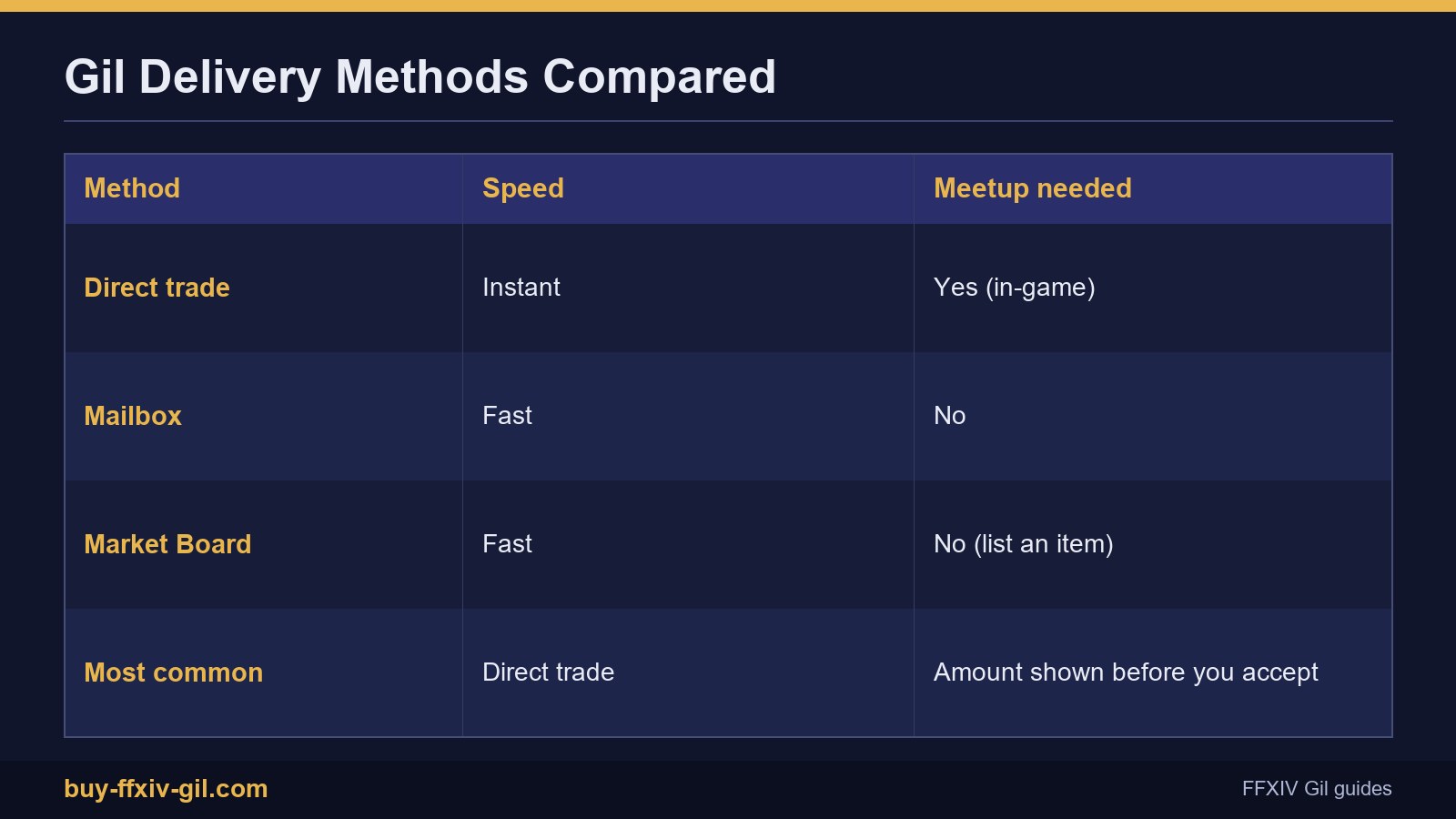
FFXIV Gil delivery methods compared: direct trade, mailbox and Market Board by speed and meetup

What to Check Before You Buy

Delivery goes smoothly when you pick a seller carefully. A few sensible checks:

  • Reputation: look for a store with a track record and real customer reviews rather than a random whisper in-game.
  • Clear pricing: the price per million Gil and any fees should be stated up front, per data center.
  • Responsive support: a contactable seller who confirms your character name, world and delivery method before starting.
  • Sensible delivery: reasonable amounts handed over at a normal pace, at a time that suits you.

Making Delivery Quick

  1. Park your character in a major city near an Aetheryte so meeting up is easy.
  2. Give the correct character name and world or data center at checkout.
  3. Keep an inventory slot or Market Board listing free for the delivery method you chose.
  4. Confirm the amount when it arrives before you head back to playing.

If you’d rather skip the grind entirely, you can buy Gil safely and pick the delivery method that suits you at checkout.

Frequently Asked Questions

What’s the fastest delivery method?

Direct trade is usually fastest — you meet in-game and the Gil changes hands immediately, with the amount visible before you confirm.

Which data centers are supported?

That depends on the store; a good seller lists NA, EU and JP options clearly and asks for your world so the deliverer is on the right server.

How long does delivery take?

For in-stock orders it’s often within minutes once you’ve confirmed your character details, though it can vary with the amount and time of day.

What information does the seller need?

Your character name and world or data center, and which delivery method you prefer. A careful seller confirms these before starting.

Read also: more FFXIV Gil guides

Making Gil with Crafting in FFXIV: A Crafter’s Guide

Crafting is the highest-ceiling way to earn Gil in Final Fantasy XIV: experienced crafters who pair Market Board knowledge with fast crafting can clear several million Gil an hour. This guide covers what actually sells, how to level Disciples of the Hand to the cap, and how to time your sales so your effort turns into profit instead of a retainer full of unsold stock.

Crafting rewards preparation over reflexes. The Gil comes from making the right items at the right time, not from crafting as much as possible.

Why Crafting Pays

Almost everything on the Market Board that isn’t a raw drop was crafted by a player: gear, food, potions, furnishings, glamour and more. That constant demand is what lets skilled crafters convert materials into Gil at a rate other methods struggle to match — figures of roughly three to five million Gil per hour get quoted for elite crafters who flip crafted goods efficiently.

What Sells Best

Demand shifts with each patch, but these categories are dependable earners:

Category Examples Why it sells
Raid consumables Food, potions, tinctures Bought constantly for Savage and prog
Glamour & housing Outfits, furnishings, dyes Players pay for style, not stats
Crafted gear Fresh-patch best-in-slot pieces Huge spike when new content drops
Materia & melds Overmelded gear, crafted materia Endgame players always need it

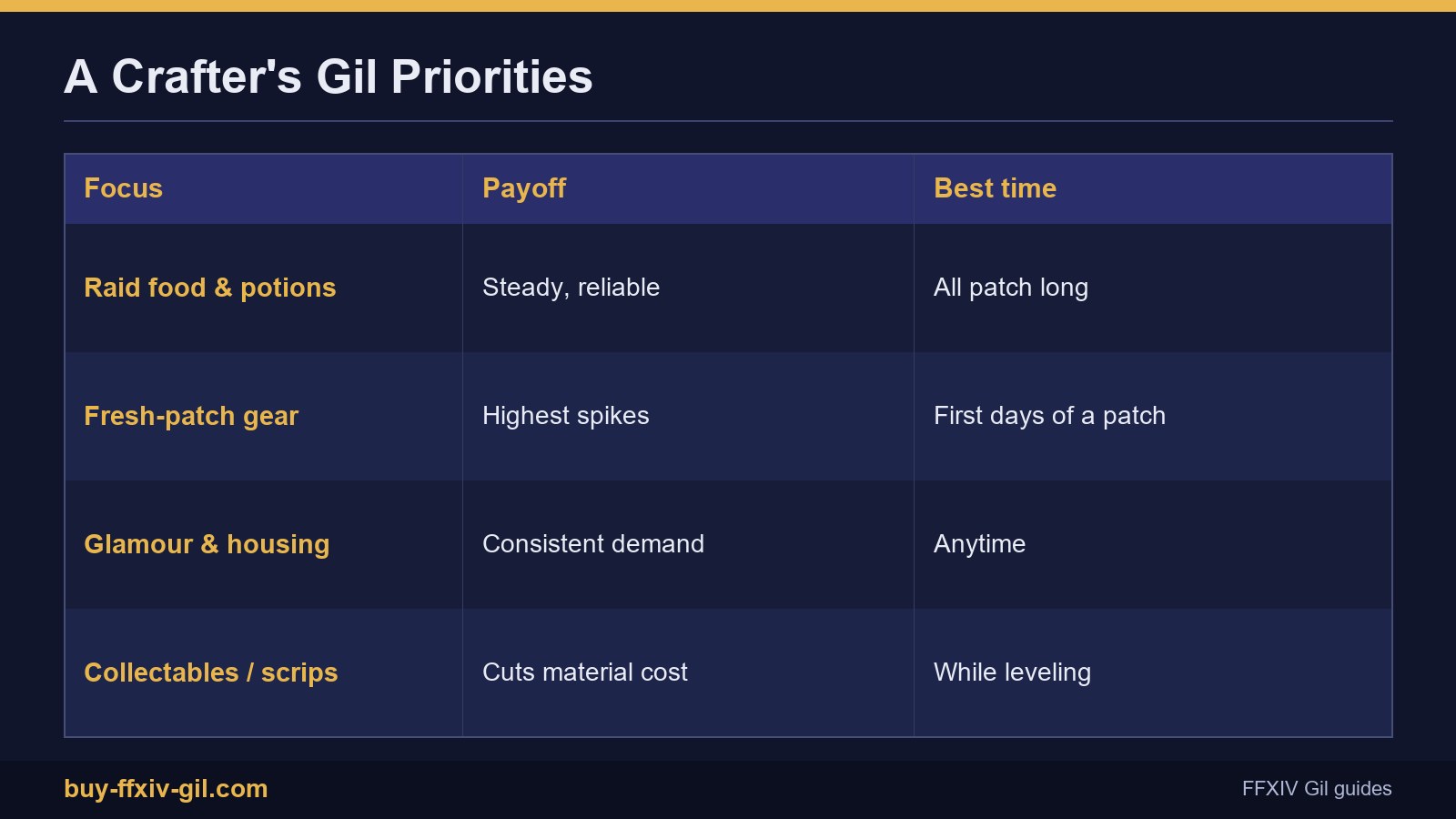
FFXIV crafting Gil priorities: raid food, fresh-patch gear, glamour, and collectables for scrips

Leveling Your Crafters

You’ll want your Disciples of the Hand at or near level 100 to make current-patch items. The fastest routes are the crafting class quests, daily crafting society (tribe) quests, and turning in collectables:

  • Collectables: craft flagged collectable items and hand them in for Scrips, which buy crafting materials, materia and gear.
  • Custom deliveries: weekly NPC turn-ins that give strong EXP and Scrips with no market risk.
  • Melded gear: as you approach the cap, meld materia to hit the crafting stats high-end recipes demand.

Timing the Market

The biggest crafting profits happen in the first days of a new patch, when best-in-slot gear, fresh food and new furnishings are in short supply and high demand. Prepare materials in advance, craft the moment content goes live, and list before the market floods. Outside patch windows, steady earners like food and glamour keep ticking over. If you need working capital to buy materials in bulk before a patch, some crafters top up with FFXIV Gil so they can corner mats early.

Frequently Asked Questions

Do I need every crafting class maxed?

It helps, because many recipes need cross-class materials, but you can start profiting with one or two leveled crafters focused on a niche like food or furnishings.

Is crafting still worth it for a solo player?

Yes. You control your own supply chain — gather or buy mats, craft, and sell — and consumables like food sell reliably even without chasing patch spikes.

What are Scrips for?

Scrips come from collectables and custom deliveries and buy crafting materials, materia and gear, which lowers your costs and raises your margins.

When should I sell crafted gear?

As early in a new patch as you can. Best-in-slot pieces command the highest prices before other crafters flood the market.

Read also: more FFXIV Gil guides

FFXIV Treasure Maps: A Gil Farming Guide

Timeworn treasure maps are one of the most reliable group Gil activities in Final Fantasy XIV: gather or buy a map, dig up the treasure, and — at the top tier — open a portal to a treasure dungeon packed with materia, dyes and Gil. This guide explains how to get maps, how solo and party runs differ, and roughly how much Gil a session is worth in Dawntrail.

Map gathering is limited per character on a timer, so the usual routine is to hoard maps through the week and run them together in a coordinated party for the best returns.

What Are Timeworn Maps?

Timeworn maps drop while you gather with a Disciple of the Land class (Miner or Botanist) once your gathering stats are high enough for the current tier. Each map points to a hidden dig spot in a specific zone; decipher it, travel there, and dig up a treasure chest guarded by monsters.

The current top tier in Dawntrail is the Timeworn Gargantuaskin Map (level 100, introduced in patch 7.3). If you don’t gather, maps also trade freely on the Market Board, so you can simply buy a stack and run them.

The Vault Oneiron Portal

The real payout comes from the portals. When a high-tier chest is opened in a party, it can spawn a portal to a treasure dungeon — for the Gargantuaskin tier that’s Vault Oneiron. Inside, your group clears themed rooms and chains as far as you can, with each room dropping materia, dyes, orchestrion rolls, crafting materials and Gil pots.

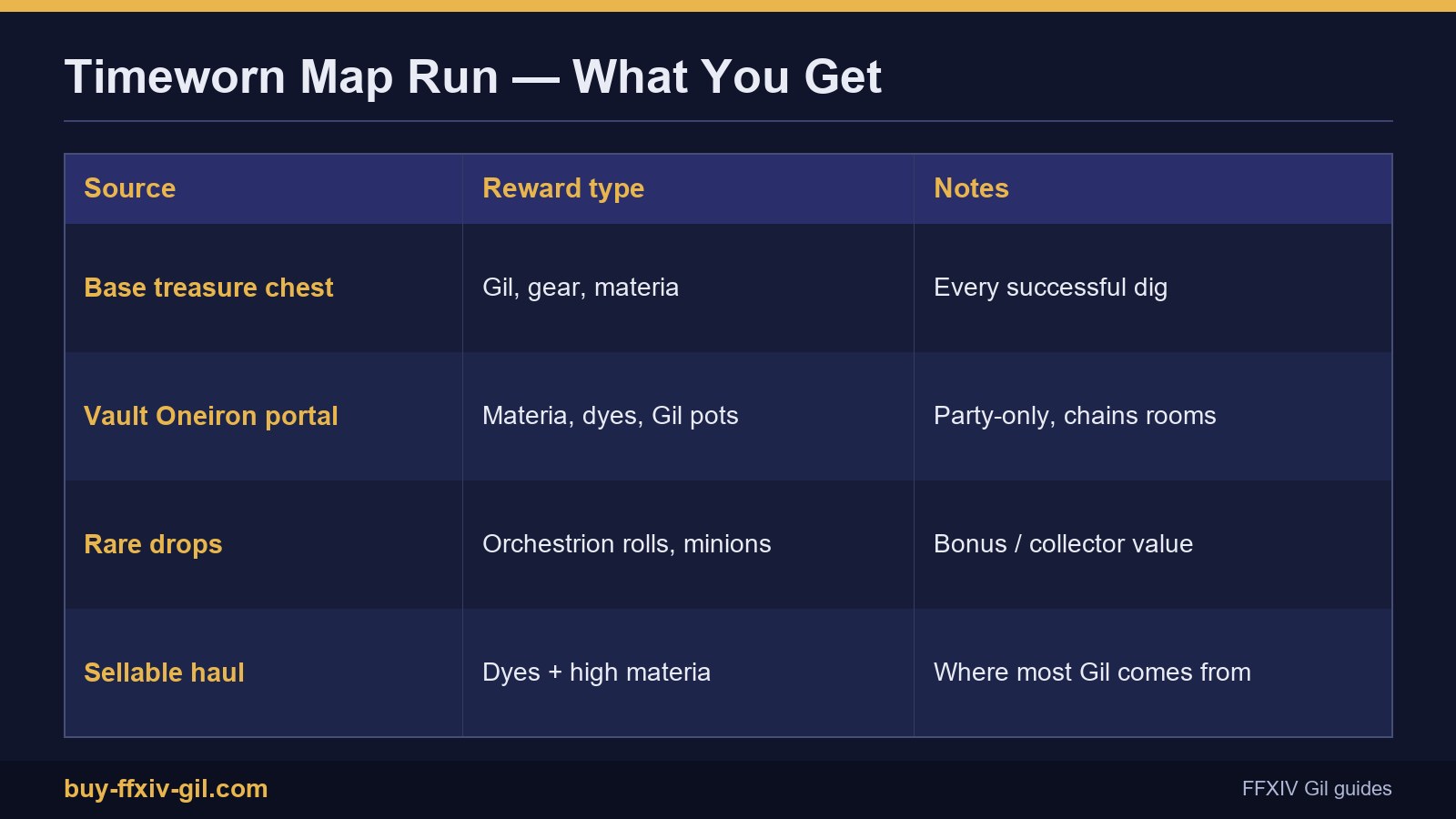
FFXIV Timeworn treasure map rewards: base chest, Vault Oneiron portal, rare drops and sellable haul

Solo vs Party Runs

  • Solo: you can dig and clear your own maps for the base chest rewards, but portals are hard to sustain alone, so the long dungeon chains are mostly out of reach.
  • Party (up to 8): pooling maps means back-to-back portals and far more rooms cleared, which is where the multi-million Gil sessions come from.

How Much Gil Per Run?

Returns depend on portal luck and how many maps the group brings, but community figures land roughly here:

Run type Time Rough Gil
Solo, base chests only ~15–30 min a few hundred thousand
Full 5-map personal chain ~30–45 min ~1–2 million
Coordinated 8-person session ~90 min ~2.5 million per player

Because the value is spread across materia, dyes and mats, your actual Gil depends on selling those drops well. If you’d rather not wait on gathering timers and map parties, you can buy cheap FFXIV Gil directly instead.

Tips to Maximise Map Income

  1. Bank your maps and run them in a full party for portal chains, not one at a time.
  2. Bring classes that clear rooms quickly; faster clears mean more rooms before the portal closes.
  3. Sell materia and dyes when prices peak (often right after a patch) rather than dumping everything at once.
  4. If you gather your own maps, keep your Miner or Botanist gear current so you can farm the top tier.

Frequently Asked Questions

Where do I get treasure maps?

Gather them with Miner or Botanist at the required gathering stats, or buy them from the Market Board if you’d rather skip gathering.

What is the current top-tier map?

In Dawntrail the top tier is the Timeworn Gargantuaskin Map (level 100, patch 7.3), which can open the Vault Oneiron treasure dungeon.

Can I run treasure maps solo?

Yes for the base chests, but portals and their dungeon chains are far more productive with a full party, so most Gil farmers run maps in groups.

How often can I get a map?

Map gathering is limited per character on an 18-hour timer, which is why players stockpile maps across the week and run them together.

Read also: more FFXIV Gil guides

FFXIV Retainer Ventures: Passive Gil While You Play

Retainer ventures are the closest thing Final Fantasy XIV has to passive income: you send your retainers out on timed jobs and collect Gil, materials and rare drops when they return, all without playing your own character. This guide covers how ventures work, the difference between combat and exploration ventures, what Venture Coffers can drop, and a simple daily routine that quietly adds up over a week.

Ventures won’t replace focused farming, but they run in the background while you do dungeons, raids or crafting. Over a full week a couple of active retainers can bank a few million Gil worth of materials and drops for a few minutes of clicking a day.

What Are Retainer Ventures?

Retainers are NPC assistants you hire to store items, sell on the Market Board and — once you unlock ventures — gather resources for you. To send ventures you spend Venture currency (earned from your Grand Company), and you assign each retainer a Disciple of War, Magic or Land class.

Each venture takes real time to finish, from around 40 minutes up to 18 hours, and returns items based on the retainer’s class, level and item level. The higher those are, the better the haul.

Combat vs Exploration Ventures

There are two broad venture types, and a common setup is to split your retainers between them:

  • Combat ventures (a Disciple of War or Magic retainer) return monster drops and gear, and their Quick Explorations carry a chance at a Venture Coffer.
  • Field ventures (a Miner, Botanist or Fisher retainer) return gathering materials such as ore, logs, fibres and reagents that you can sell or feed into crafting.

Whichever class you pick, the retainer’s stats need to be high enough for the top ventures, so it pays to keep their gear reasonably close to your own.

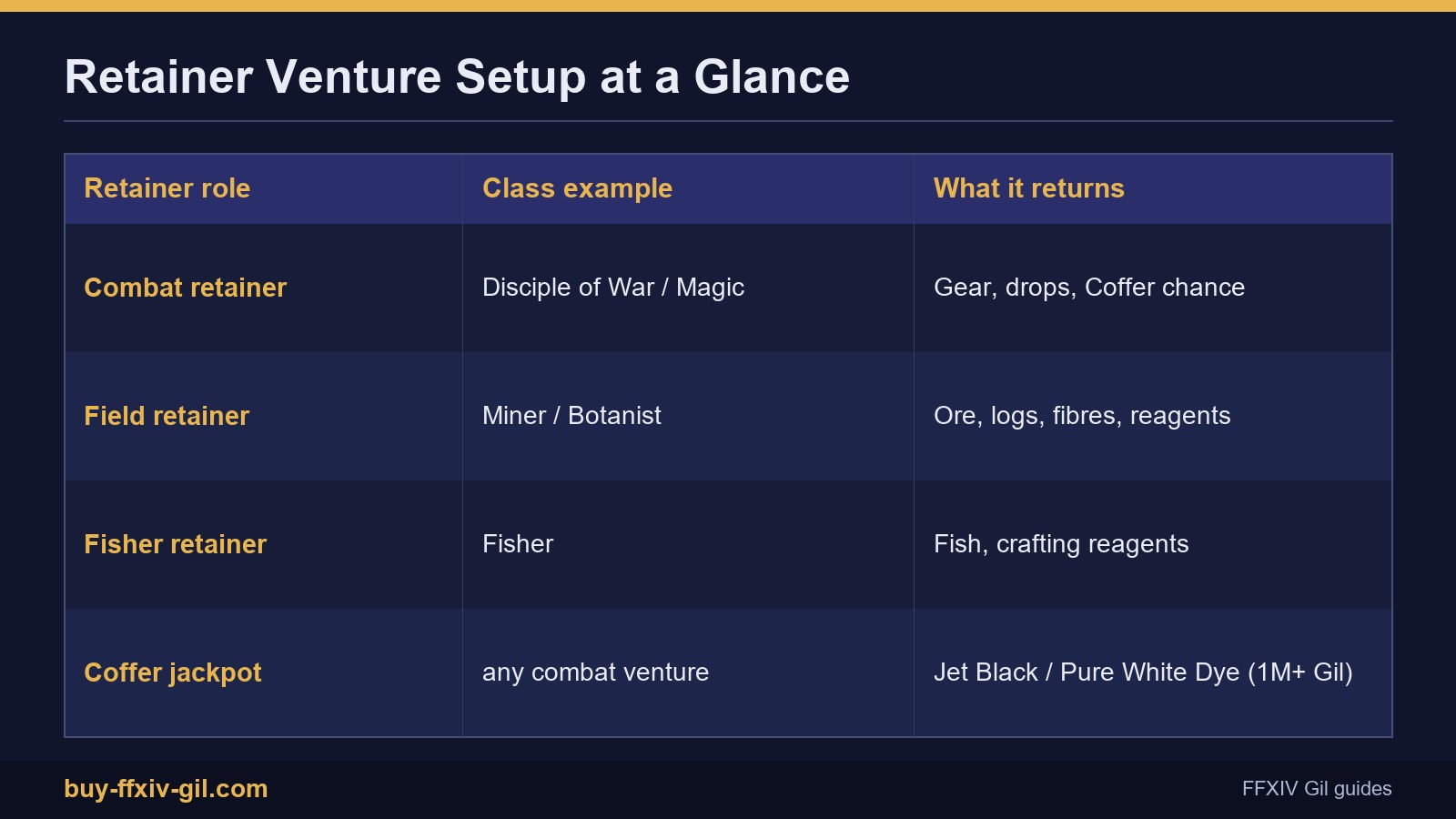
FFXIV retainer venture setup: combat, field and fisher retainers and their Gil returns

Venture Coffers and Dye Drops

The headline reward is the Venture Coffer, which has a chance to drop from short (roughly one-hour) Quick Exploration combat ventures. Coffers can contain highly sought-after items — most famously Jet Black Dye and Pure White Dye, which can sell for over a million Gil each depending on your server and current supply.

They’re not guaranteed, so treat coffers as a bonus on top of the steady materials income rather than a reliable payday.

How Much Gil Can Ventures Make?

Numbers swing with your server economy and the patch, but as a rough guide:

Setup Effort Rough weekly value
Two retainers, materials focus ~5 min/day ~1–2 million Gil
Two retainers plus coffer luck ~5 min/day 2–3 million Gil
Extra retainers (up to 10 with added slots) scales up several million Gil

The key word is passive: this Gil arrives while you’re busy with something else. If you’d rather not wait on timers, you can also top up your Gil balance and skip straight to spending it.

A Simple Daily Venture Routine

  1. Log in and collect any completed ventures from your retainers.
  2. Sell or stockpile the returned materials on the Market Board.
  3. Re-assign each retainer — keep one or two on Quick Exploration combat ventures for coffer chances, the rest on the highest-yield field ventures they can run.
  4. Restock Venture currency from your Grand Company when you run low.

Do this once a day and the returns compound quietly in the background while you play the content you actually want to play.

Frequently Asked Questions

How many retainers can I have?

Two per character by default, and up to ten if you add extra retainer slots through the optional retainer service. More retainers means more ventures running in parallel.

Do I need to level my retainer?

Yes. A retainer’s class level and item level cap the ventures it can run and how much it brings back, so keep their gear updated to reach the higher-yield ventures.

Which is better, combat or exploration ventures?

Exploration ventures give steadier material income, while combat Quick Explorations add the chance of a Venture Coffer. Splitting your retainers between both is the usual approach.

Are Venture Coffers guaranteed?

No. Coffers are a random chance from short combat ventures, so treat the dye jackpots as an occasional bonus rather than dependable income.

Read also: more FFXIV Gil guides