
FFXIV Retainer Ventures: Passive Gil While You Play
Retainer ventures are the closest thing Final Fantasy XIV has to passive income: you send your retainers out on timed jobs and collect Gil, materials and rare drops when they return, all without playing your own character. This guide covers how ventures work, the difference between combat and exploration ventures, what Venture Coffers can drop, and a simple daily routine that quietly adds up over a week.
Ventures won’t replace focused farming, but they run in the background while you do dungeons, raids or crafting. Over a full week a couple of active retainers can bank a few million Gil worth of materials and drops for a few minutes of clicking a day.
What Are Retainer Ventures?
Retainers are NPC assistants you hire to store items, sell on the Market Board and — once you unlock ventures — gather resources for you. To send ventures you spend Venture currency (earned from your Grand Company), and you assign each retainer a Disciple of War, Magic or Land class.
Each venture takes real time to finish, from around 40 minutes up to 18 hours, and returns items based on the retainer’s class, level and item level. The higher those are, the better the haul.
Combat vs Exploration Ventures
There are two broad venture types, and a common setup is to split your retainers between them:
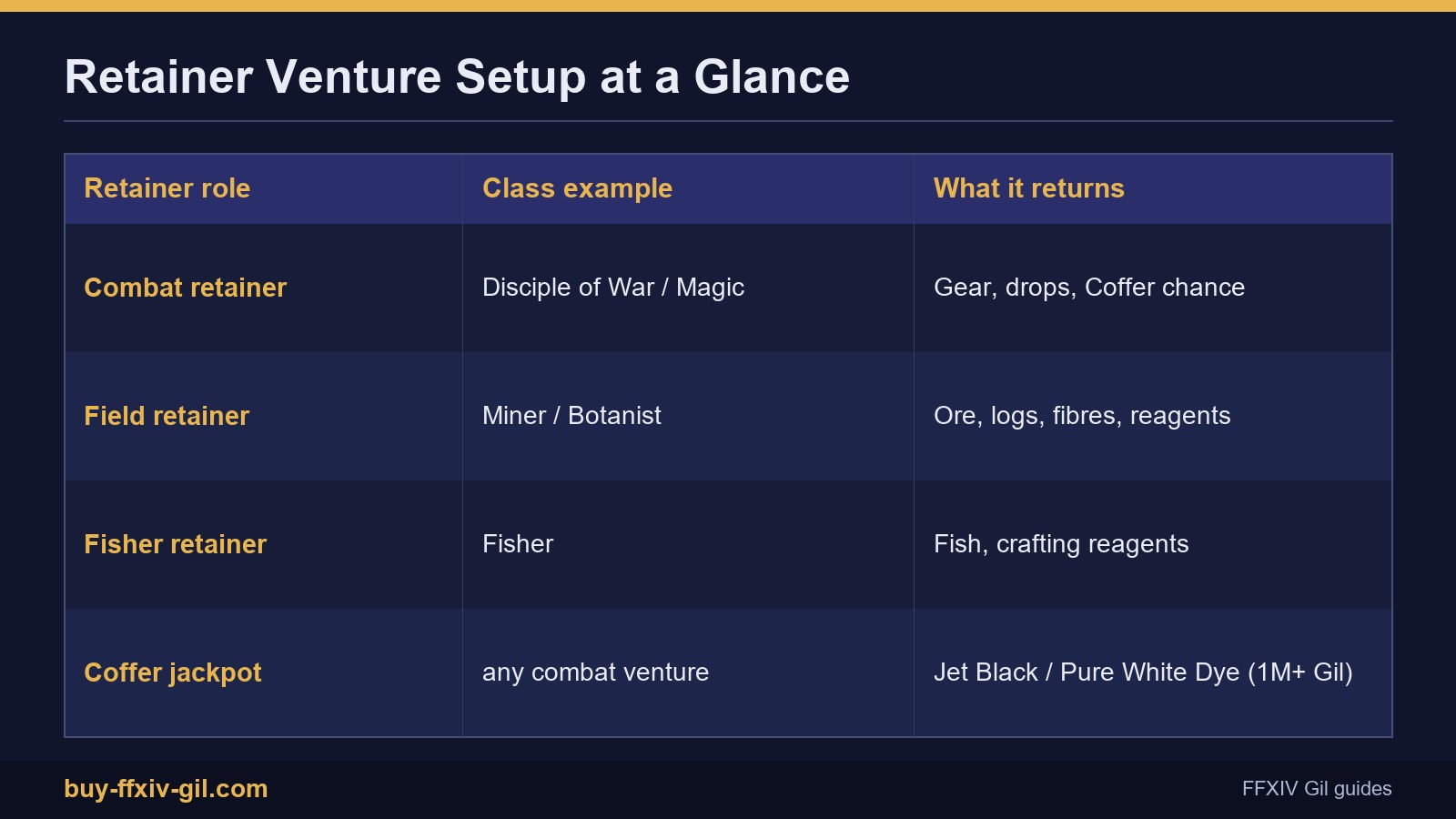
- Combat ventures (a Disciple of War or Magic retainer) return monster drops and gear, and their Quick Explorations carry a chance at a Venture Coffer.
- Field ventures (a Miner, Botanist or Fisher retainer) return gathering materials such as ore, logs, fibres and reagents that you can sell or feed into crafting.
Whichever class you pick, the retainer’s stats need to be high enough for the top ventures, so it pays to keep their gear reasonably close to your own.
Venture Coffers and Dye Drops
The headline reward is the Venture Coffer, which has a chance to drop from short (roughly one-hour) Quick Exploration combat ventures. Coffers can contain highly sought-after items — most famously Jet Black Dye and Pure White Dye, which can sell for over a million Gil each depending on your server and current supply.
They’re not guaranteed, so treat coffers as a bonus on top of the steady materials income rather than a reliable payday.
How Much Gil Can Ventures Make?
Numbers swing with your server economy and the patch, but as a rough guide:
| Setup | Effort | Rough weekly value |
| Two retainers, materials focus | ~5 min/day | ~1–2 million Gil |
| Two retainers plus coffer luck | ~5 min/day | 2–3 million Gil |
| Extra retainers (up to 10 with added slots) | scales up | several million Gil |
The key word is passive: this Gil arrives while you’re busy with something else. If you’d rather not wait on timers, you can also top up your Gil balance and skip straight to spending it.
A Simple Daily Venture Routine
- Log in and collect any completed ventures from your retainers.
- Sell or stockpile the returned materials on the Market Board.
- Re-assign each retainer — keep one or two on Quick Exploration combat ventures for coffer chances, the rest on the highest-yield field ventures they can run.
- Restock Venture currency from your Grand Company when you run low.
Do this once a day and the returns compound quietly in the background while you play the content you actually want to play.
Frequently Asked Questions
How many retainers can I have?
Two per character by default, and up to ten if you add extra retainer slots through the optional retainer service. More retainers means more ventures running in parallel.
Do I need to level my retainer?
Yes. A retainer’s class level and item level cap the ventures it can run and how much it brings back, so keep their gear updated to reach the higher-yield ventures.
Which is better, combat or exploration ventures?
Exploration ventures give steadier material income, while combat Quick Explorations add the chance of a Venture Coffer. Splitting your retainers between both is the usual approach.
Are Venture Coffers guaranteed?
No. Coffers are a random chance from short combat ventures, so treat the dye jackpots as an occasional bonus rather than dependable income.